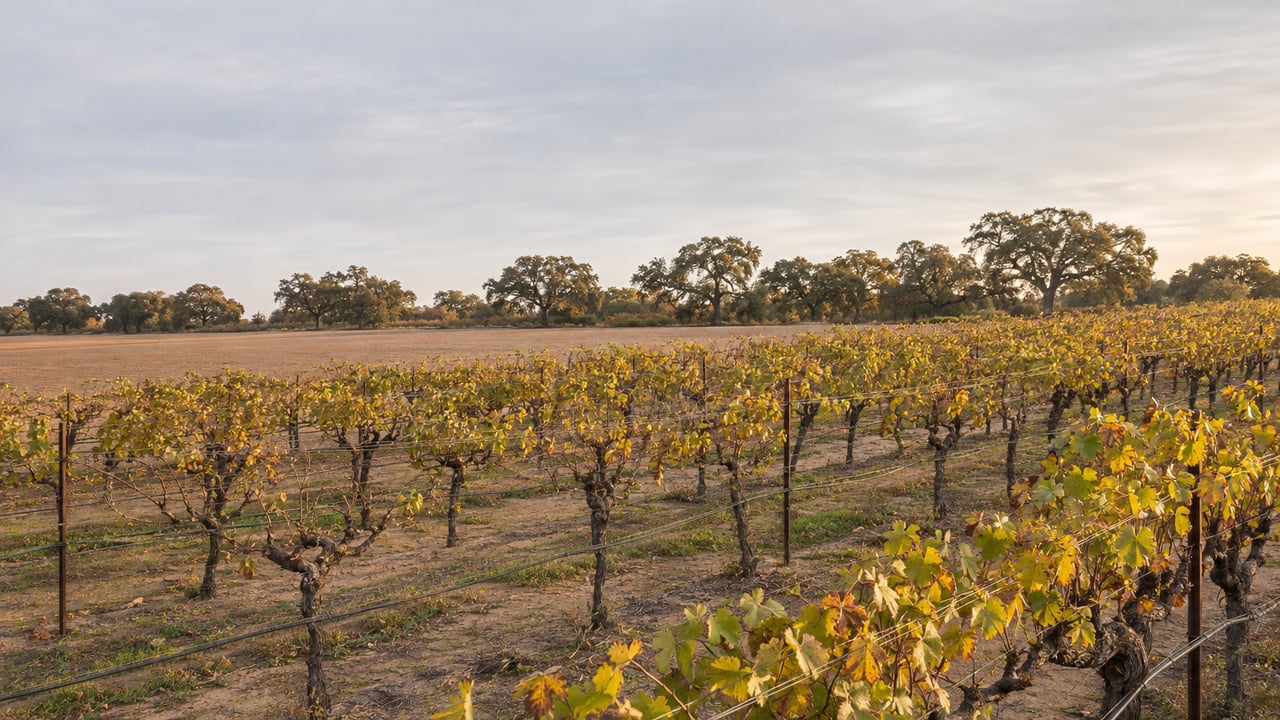
In September, Bill Berryhill stood in a block of merlot that nobody had agreed to buy. Berryhill farms 500 acres near Lodi as Berryhill Family Vineyards. He told KCRA he had no buyers for the grapes on 200 of those acres and planned to pull 50 acres of vines after harvest.
That matters to someone comparing rural parcels between Acampo, Lockeford and the north edge of Lodi. Neat rows of mature vines used to read as value already in the ground: someone else had planted them, trained them and brought them into production. In this market, two parcels with the same vines can be worth very different amounts. What separates them is whether a winery or broker will buy that block's fruit. A block with a buyer produces income that can be valued, and a block without one carries a real cost to clear. A buyer who prices the vines without asking about their buyer is guessing.
Price Per Ton Fell a Little. Acreage Fell a Lot.
San Joaquin County's agricultural commissioner publishes the county's crop figures each year, and the most recent report compares the 2025 grape crop with 2024. Bearing grape acreage fell from 83,400 acres in 2024 to 67,800 in 2025. Tonnage fell from 535,000 to 472,000, and total grape value fell from about $319.3 million to $272 million. The county reported that the 18.65% drop in acreage, along with a slight price decline, pushed grapes down to fifth place among its crops.
| San Joaquin County grapes | 2024 | 2025 | Change |
|---|---|---|---|
| Bearing acres | 83,400 | 67,800 | down 15,600 acres |
| Tons | 535,000 | 472,000 | down 63,000 tons |
| Total value | $319.3 million | $272 million | down about 15% |
| Average price per ton | $597 | $575 | down about 4% |
A drop of about 4% in the average price per ton, 2024 to 2025, looks like a market that bent without breaking. That average only counts grapes someone bought. Fruit that went unsold never got a price, so it doesn't show up in the average at all. Over those two years, the county's grape value fell mostly because acres came out of production, while the price on fruit that did sell slipped only slightly.
Zinfandel, the grape most tied to Lodi's name, shows how far that has gone. Turrentine Brokerage reported in March 2026 that District 11, the crush district that includes Lodi, crushed 51,400 tons of Zinfandel in 2025. Before 2023 the usual figure was more than 100,000 tons.
Half the Crop Went Into Harvest Without a Contract
Under contract, a grower sells to a winery at an agreed price before harvest. In most years that arrangement covers the bulk of California's crop. Jeff Bitter, president of Allied Grape Growers, told KCRA that about half of the state's 2026 winegrape crop started harvest without a contract. In a typical year, 70% to 80% is contracted. Bitter said that, with luck, growers can sell uncontracted grapes at a loss to buyers making concentrate. In the same report, Kyle Collins, a Lodi-based operations manager with Allied Grape Growers, stood in a Lodi petite verdot block and said there was no buyer for those grapes. He said the same was true for many growers nearby.
The 2025 harvest gave an early look. Lodi grower Bill Stokes of Stokes Vineyards told CBS Sacramento that 2025 was the first year a vineyard planted in 1991 and 1992 went unharvested.
For a buyer, this means the most valuable document about a vineyard parcel may be its fruit agreement, not its planting record. A long-term contract with a named buyer and price is income, and that income can be valued. A vineyard whose buyer quit two harvests ago may look identical from the road, but its main job now is to keep the ground in farming while the owner decides what comes next.
Pulling Vines Costs More Than It Did
Once vines lose their buyer, the cost of removing them becomes part of the price. WineBusiness Monthly's May 2026 vineyard survey reported that removing a vineyard in the San Joaquin Valley now costs $2,000 to $3,000 per acre. Before burning removed vines was banned, it ran $1,500 to $1,600. On a 20-acre ranchette planted wall to wall, that works out to $40,000 to $60,000 to clear the ground at 2026 rates, before any replanting.
In April 2026, the San Joaquin Valley Air District adopted updated per-acre incentive rates for alternatives to burning removed vines, listed in its June 2026 board item. The cost figures in this post are general information, not legal, tax or financial advice, so confirm your own situation with the right professional before you count on any of them.
Owning vines also costs more each year. In the same WineBusiness Monthly report, Chris Indelicato of Delicato Family Wines said farming costs have risen about 65% over the past five years. For anyone buying vines and planning to keep farming them, that increase comes on top of a fruit market that, by Bitter's account, has not recovered.
The Land Market Has Already Repriced Vineyards
These pressures have already shown up in what vineyard land sells for. Janie Gatzman, a Stanislaus County appraiser and co-chair of the California Chapter of the American Society of Farm Managers and Rural Appraisers' annual Trends report, told Ag Alert that Lodi-area vineyards lost 35% to 40% of their value from 2023 to 2024. The article separated that drop from the groundwater worries hitting orchard land elsewhere in the valley. It tied the vineyard decline to a historic fall in wine demand.
The grape trade said as much before then. In February 2024, the Lodi Winegrape Commission wrote that older or diseased vineyards may be hard to farm profitably and that bare land may be more valuable to resell or lease. The local industry group was telling growers that, for some blocks, the vines could be worth less than nothing.
The removals have kept going since. The California Vineyard Mapping Project counted 7,991 acres removed in the Lodi appellation between October 2024 and Aug. 1, 2025, according to the Lodi News-Sentinel. In the following year, Aug. 1, 2025 to Aug. 1, 2026, the project counted 47,229 acres removed statewide.
What the Ground Becomes Next
Since buyers are now paying mostly for the ground, the next question is what that ground can do without vines. Lodi growers are answering it in the field. Mohr-Fry Ranch removed a vineyard block and planted safflower to transition the soil, with olives as the likely next permanent crop, the Lodi News-Sentinel reported. The same paper noted almonds, pistachios and olives going in around Lodi, and some growers leasing land for groundwater recharge basins. Statewide, KCRA described growers choosing among harvesting at a loss, leaving fruit on the vine, or replanting to crops in higher demand such as almonds, walnuts, pistachios and olives.
On a parcel where the house matters as much as the farm, the options are broader. Some buyers want a few acres of working vines and some don't. Removed vines can open up pasture, a barn site, an orchard or simply room. Every one of those uses starts with clearing the vines, so the removal cost belongs in the offer, not in a surprise later.
Reading an Acampo Listing With Vines
Any vineyard parcel comes down to a short order of questions. The first is whether the fruit has a buyer, under what kind of agreement, and for how long. With a current buyer, the vines produce income you can weigh against the 2025 county average of $575 a ton. Without one, assume the vines will need to come out and set aside $2,000 to $3,000 an acre at 2026 rates. Next come variety and age. The Zinfandel crush has been cut roughly in half, and the Commission singled out older and diseased blocks as the hardest to farm profitably. Last is what the land would be used for after the vines are gone, which by now is often what a buyer is really paying for.
A seller who has a contract in hand has something real to show. A seller whose fruit sat unpicked last fall isn't hiding anything. The vines on that parcel are just priced differently now, and the listing price should reflect that.
Quick Answers
Do planted vines still add value to rural land near Lodi? Only if someone will buy the fruit. Lodi-area vineyard values fell 35% to 40% from 2023 to 2024, and about half of California's 2026 crop went into harvest without a contract.
What does it cost to remove a vineyard here? WineBusiness Monthly put San Joaquin Valley removal at $2,000 to $3,000 per acre as of May 2026.
What are Lodi growers planting instead? Lodi News-Sentinel and KCRA coverage names safflower as a transition crop, plus olives, almonds, pistachios and walnuts. Some ground is also leased for recharge basins.
If you're weighing a parcel with vines around Acampo or Lodi, we're glad to walk the rows with you. We can read the fruit agreement, price the cost of clearing the ground and look at what the land can become. Our property divisions bring together team members with hands-on farming backgrounds for exactly this kind of parcel. If you own vineyard land and want to know where it stands today, start with a property valuation from Chandler Gross Group. Let's Connect.